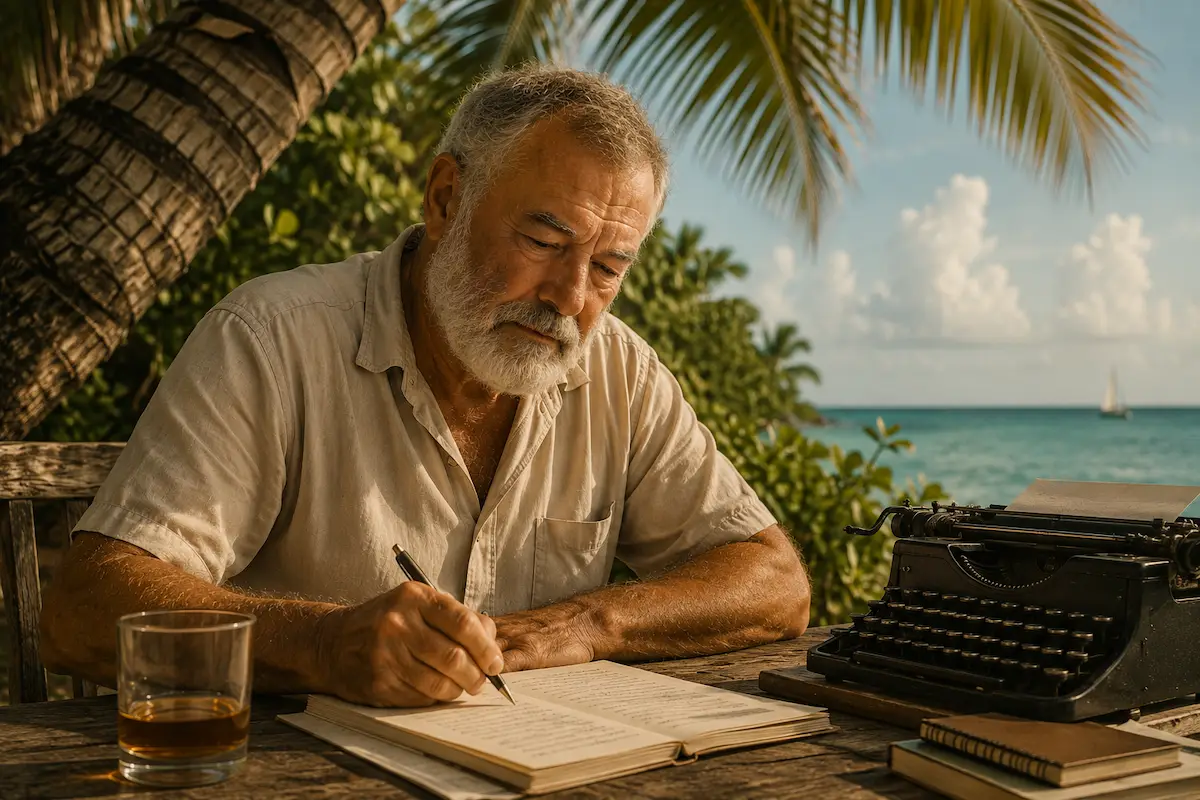

A century later or so, you can drive all the way down the Florida Keys, cross the Cow Key Bridge into Key West, cruise Duval Street and Old Town, and still find Ernest's shadow hanging around.
Not literally, of course.
Although this is Key West and I probably should not rule anything out.
He Wasn't Supposed to Stay
Hemingway arrived in 1928 after coming across from Havana. Key West was supposed to be little more than a stop along the way.
Then something wonderfully inconvenient happened: the Ford automobile that was supposed to be waiting for him had not arrived.
So Hemingway waited...and waited.
And while waiting, he discovered a key. Some key!
In fact, the delay turned out to be one of those accidents that history occasionally throws into the road to explain the birth of wonders.
Because Hemingway encountered an island of fishermen, sailors, wreckers, drinkers, eccentrics, workers, and characters who seemed capable of walking straight into one of his books.
He liked the place.
And, guess what, the place liked him.
Whitehead Street
Sometime in 1931, Hemingway and his second wife, Pauline Pfeiffer, made their home at 907 Whitehead Street.
Today the Ernest Hemingway Home and Museum is one of the most famous stops in Key West. Visitors walk through the tropical grounds, see the house, look into Hemingway's writing space and inevitably encounter the famous six-toed cats wandering around as if they were the owners.
Yet, knowing cats like I know them, I'd say the kitties probably believe they do actually own the property.
But Beneath the Tourist Attraction Lies Something Much More Interesting
Hemingway actually worked here and back then there were cats there, too.
Those years were one of the most productive periods of his career. He wrote, revised, observed people, and absorbed the strange mixture of poverty, wealth, isolation and adventure surrounding him.
Here Comes the Water
You cannot really understand Hemingway's relationship with the Florida Keys by staying on land.
The water mattered. It certainly did.
Local hardware-store owner Charles Thompson helped introduce Hemingway to big-game fishing, and Hemingway took to it with the enthusiasm of a man who rarely did anything halfway.
The Gulf Stream beyond Key West became another world for him.
Marlin.
Tuna.
Long days offshore. Trips toward the Dry Tortugas, Cuba, and the waters around the Straits of Florida.
And, in 1934, Pilar — his famous fishing boat — came into his life.
The boat became almost as closely associated with Hemingway as the typewriter and the beard. From Key West and later Cuba, Pilar carried him into the blue-water life that would repeatedly find its way into his imagination.
For Hemingway, fishing was never just about catching a fish.
It was struggle.
Patience.
Failure.
Pride.
A man against something larger than himself.
Sound familiar?
Key West Wasn't Always a Postcard
It is easy to look at modern Key West and see frozen drinks, souvenir shops, sunset cruises and crowds taking selfies beside the Southernmost Point.
Hemingway knew another Key West.
The 1930s brought the Great Depression, economic hardship and a very different island from the tourism machine we know today.
Hemingway watched that world closely.
It eventually became part of To Have and Have Not, his novel about fishing-boat captain Harry Morgan and a Depression-era Key West filled with desperation, class divisions, smuggling, and survival.
Hemingway did what writers do best when they are paying attention: he stole from reality.
But not the facts exactly.
The texture.
The voices. The desperation. The sea. The people. The smell of the docks. The feeling of living at the very bottom of the American map with Cuba sitting just across the water.
Papa and the Key West Mob
Hemingway also collected friends.
His Key West circle included fishermen, businessmen, and local characters. They drank together, traveled together, and disappeared on fishing trips that could stretch for days.
Among them was Joe Russell, forever connected with the Key West legend of Sloppy Joe's.
Hemingway's group became known as his "Mob," and the nickname Papa followed him through much of the rest of his life.
This is where history becomes difficult to separate from legend.
Key West has had decades to polish the Hemingway stories, enlarge them, put them behind a bar, print them on a T-shirt, and sell them back to us.
Hemingway himself probably would have appreciated the hustle.
The Hemingway Key West Still Sells
Walk through Key West today and Hemingway is everywhere.
His house.
His photographs.
His fishing stories.
His drinking stories.
His cats.
His name is attached to festivals, contests, bars, souvenirs, and enough merchandise to make a dead minimalist writer wonder what the hell happened.
Some of it is history.
Some of it is marketing.
Some of it has probably been exaggerated after decades of rum, storytelling and Florida sunshine.
But underneath all of that commercial noise is something genuine.
Hemingway really was here.
He walked these streets. He knew these waters. He knew the fishermen. He watched the island struggle through the Depression. He sat down and turned pieces of what he saw into literature.
Drive Until the Road Runs Out
That may be the best reason to include Hemingway in any journey through the Florida Keys.
His story belongs to the road.
Drive south from Key Largo and the mainland slowly disappears behind you. Pass Islamorada. Cross Marathon. Roll across the Seven Mile Bridge. Continue through the Lower Keys until US 1 finally delivers you into Key West.
Then get out of the car.
Walk. Walk. Walk.
Strut Duval Street for a while. Wander through the quieter alleys of Old Town. Turn and run into Whitehead Street. Stand outside the walls of Hemingway's old house and remember that before the museum tickets, the gift shops, and the legend, there was simply a writer living on a strange tropical island at the end of a long road.
He wrote.
He fished.
He drank.
He lived.
And Key West did what Key West has always done best.
It gave him stories.
Mile by mile. Island by island. Story by story.